The accounts you're quietly losing — and how your own service history already knows.
Six weeks ago, a hospital you've serviced for years was mid-conversation about renewing the preventive-maintenance contract on its imaging fleet. A real relationship. A real, open deal. Then the quarter got busy — three go-lives, a parts shortage, a technician out sick — and the thread went quiet. Nobody decided to drop it. It just slipped. The renewal is still open. The hospital hasn't heard from you in 68 days. And it's not the only account in that state right now; it's just the one you happen to remember.
This happens to every medtech distributor and manufacturer, and almost never out of negligence. It's volume. You've placed devices for years. You're tracking hundreds of accounts, open jobs and service tickets at once. Inboxes are full. Newsletters and PM reminders go out automatically, which makes a silent account look contacted when nobody has actually spoken to them. Finished service jobs and closed deals clutter the view. The signal that an active, valuable relationship has gone quiet is in your system — it's just buried where no human can find it by hand.
So what if you could just ask? Not build a report. Not export to a spreadsheet and start colour-coding. Just type the question a sharp commercial lead would ask if they could see everything at once:
"Which accounts have we gone quiet on?"
That's the shift. Your installed base is your most underused revenue engine — every device you've ever placed is a future PM contract, a consumables stream, an upgrade conversation. The history needed to work it has always been there. What's been missing is a way to ask it a plain-language question and get back a short, trustworthy answer.
How it actually works
It doesn't just tell you who's quiet — it tells you who's cooling off, which is the part you can act on. It looks at three things separately: how engaged a relationship is, which way that engagement is trending, and how recently there was real, two-way contact. A meeting or a returned call counts. Sending someone your newsletter does not — the system knows the difference between staying in touch and looking like you did.
Then it does the part that matters: it knows the difference between an account that drifted and one that was never really engaged, already finished, or that said no. And it pairs "we've gone quiet" with "there's still money on the table." That combination — a real relationship, cooling, with an opportunity still open — is your priority list. The result isn't a 500-row export nobody reads. It's a handful of names worth acting on this week, ranked by what's at stake. And if a meeting's already booked to re-engage an account, it won't cry wolf — it only flags the genuine slips.
Show it
Ask the question, and instead of thousands of accounts you get something like this:
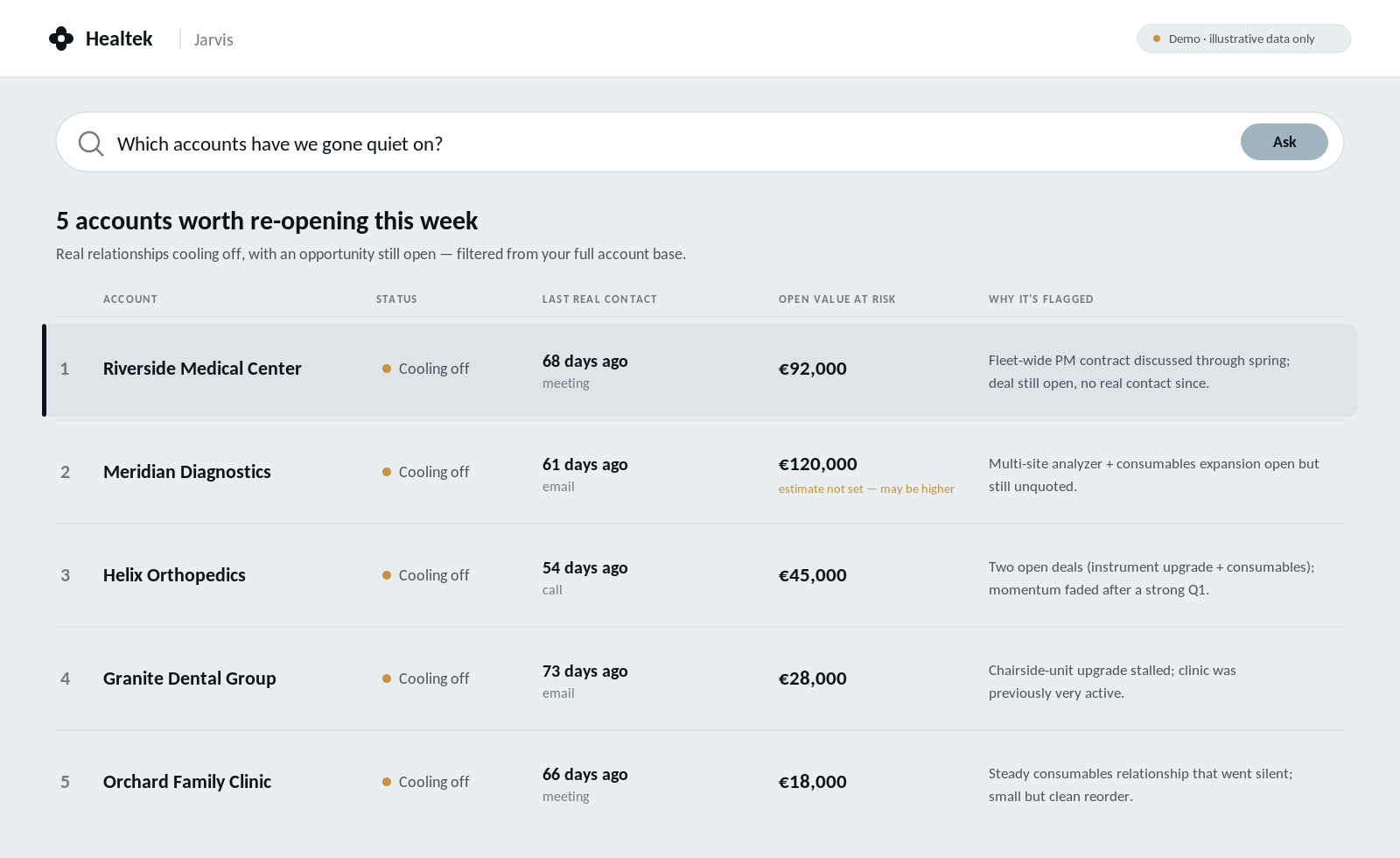
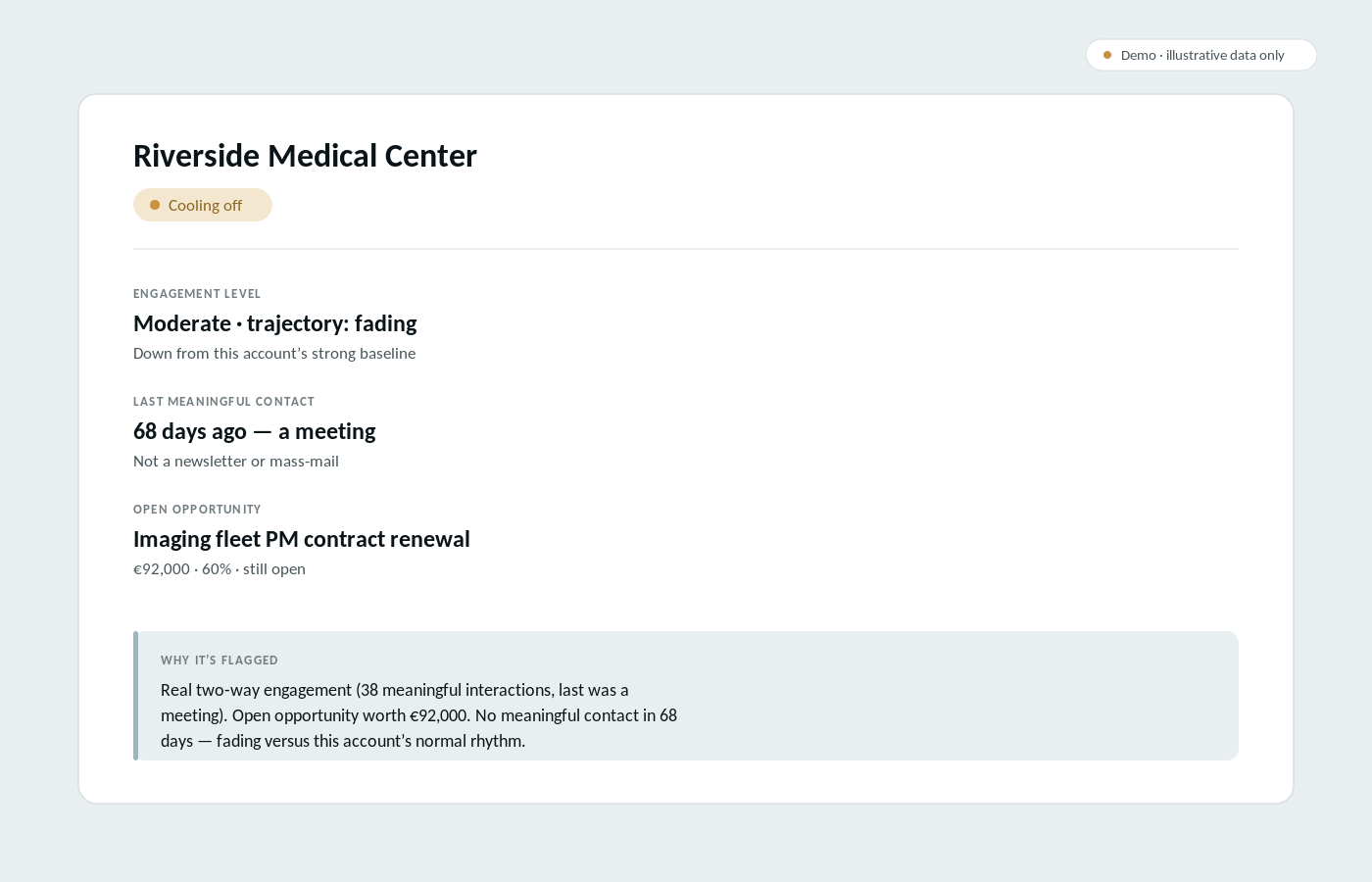
Take the top row. Riverside Medical Center: real two-way engagement over the years — dozens of meaningful interactions, the last of which was a meeting, not a mass-mail. An open opportunity worth €92,000: a fleet-wide PM contract renewal, still live. And no meaningful contact in 68 days — fading against this account's own normal rhythm. That last line is the whole point. The system isn't guessing the hospital is unhappy; it's showing you a valuable, active relationship that has quietly cooled while an opportunity sits open.
Why only a medtech-native system can do this
This works because Healtek holds years of communication-in-context — and because it understands what a serial number, a PM interval, a service protocol and an open quote actually are. A generic CRM tracks contacts. A generic ERP counts money. A bolt-on AI tool reading a thin CRM can't see the difference between a hospital that drifted and one that finished its programme, because it never had the service and device history in the first place. The "gone quiet" answer is only as good as the context underneath it, and that context is exactly what a medtech operating layer keeps under one roof.
Ask your own data
You don't need a new data project to find this revenue. It's already in your history. The only thing that's been missing is the ability to ask the right question and trust the answer. Ask your own installed base which accounts you've gone quiet on →
Owner: Jan Safka · Healtek field notes, June 2026. Demo accounts and figures are fabricated for illustration and are not real Healtek clients or results.