Devices without borders.
A European citizen can drive from Ostrava to Žilina without showing a passport. A European endoscopy tower cannot. The moment it crosses that line inside the same company group, it needs a new product code, a new price in a new currency, a new name on the protocol, a new inspection calendar under a new national law — and, in most distributors, a new system to hold all of that. The single market was built for people and goods. Nobody told the software.
Twenty-seven small markets in a trench coat
Here is the medtech distributor's European problem in one sentence: the markets are small and the rules are not. A country of five or ten million people is a modest installed base, but it comes with the full apparatus — its own language on every document a hospital signs, its own currency on every price list, its own law saying how often a device must be safety-checked and what the protocol must contain. MDR gave Europe one regulation for placing a device on the market; it did not give it one regulation for keeping it alive in a hospital for ten years. That part is national, and it multiplies.
So growth by geography — the natural move for anyone who has done well in one country — comes with a tax. Each border adds a copy: of the catalogue, of the price list, of the protocol templates, of the system. And each copy quietly ends the group. The devices are yours on both sides of the line; the data that knows them is not.
Give the device a passport
The audacious version of the fix is not "integrate the copies". It is: stop making copies. One group, one instance, one record per product — and let the record carry everything a border would otherwise demand.
The product is identified once, by the identifiers the world already agrees on — GTIN or EAN, the manufacturer's part number, the UDI device identifier — so a Czech entity and a Slovak entity mean the same thing when they say its name. Its name and description carry every language the group trades in, so a quote in Prague and a protocol in Bratislava print from the same source and never disagree. Prices live only in price lists — one per entity, one per currency — so a CZK list and a EUR list can differ all they like without the product forking in two. The device itself knows where it is installed, whether it is sold, loaned or rented, and when its warranty ends. And the thing the borders guard most jealously — the inspection law — becomes configuration on an activity type: performed date, next-due date, the cycle the local statute demands. Twelve months in one country, a different rhythm in the next; the device does not care, and neither does the code.
That is the passport. A device carrying it can be sold by one entity, installed by another, serviced by a technician from a third, and invoiced in whichever currency the hospital pays in — and it remains, throughout, one device with one history.
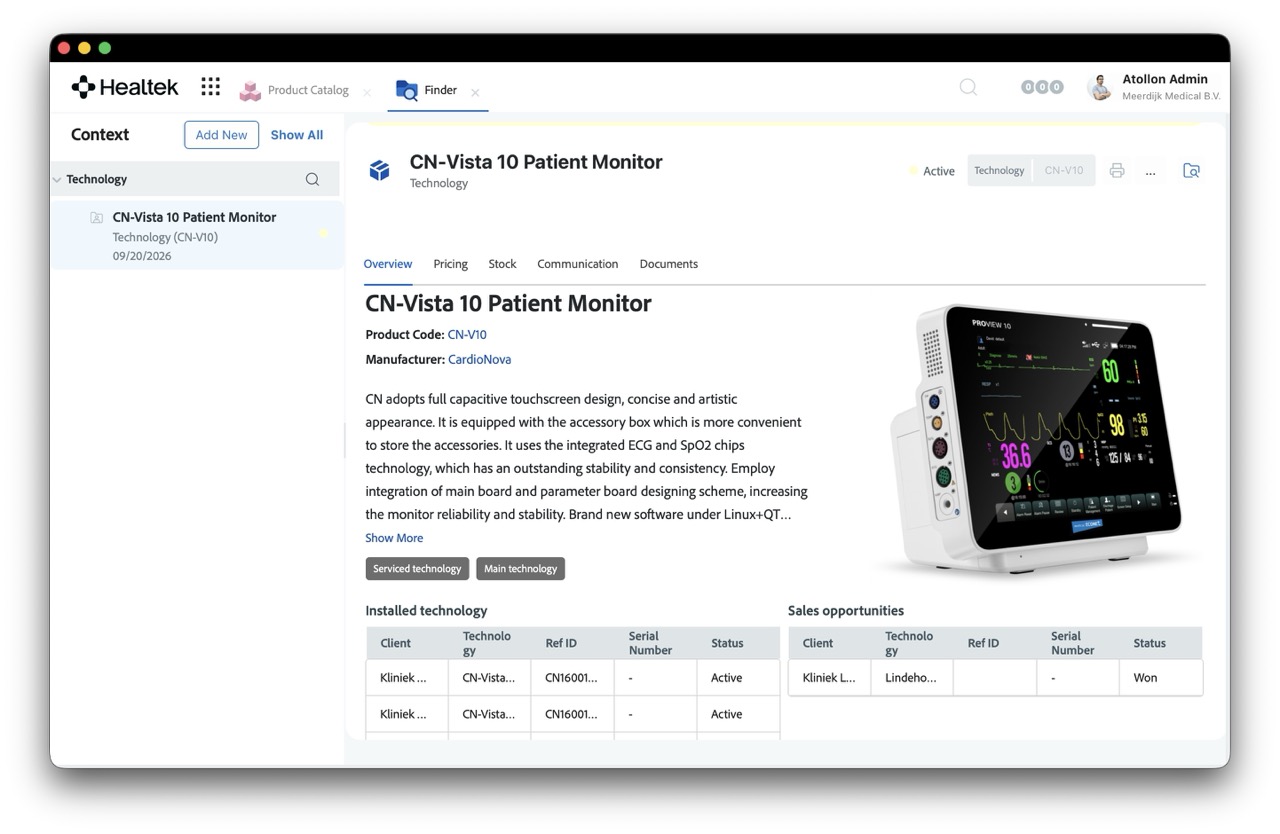
What you see when the borders are gone
This is where it stops being tidy and starts being valuable. With one record, the group view is not a reporting project someone will get to next year; it is the same data with one filter removed. Which technologies sell in one country and have never been offered in the other. Which hospital groups buy from you on one side of the border and not yet on the other. Where the installed base is due for inspection next quarter — all of it, not the half your local system can see. Margin by entity in comparable terms, because "the same product" finally is. The opportunity a cross-border distributor most often misses is the one its own data already contains. The borders did not just cost you effort. They cost you the view.
Where this is happening
Imedex, the distributor documenting its Healtek journey in public, runs a Czech entity in CZK and a Slovak entity in EUR on one instance with one shared product catalogue. Product texts are arriving in Czech, Slovak and English; the service configuration from journey update #3 crosses into the Slovak entity next. Multi-organisation is how the platform was built from the start; what this round added is the shared catalogue across entities with different base currencies — which the next group receives by configuration, not by project.
And this only works when the platform itself owns the meaning of the data — not a field bolted onto one client’s form, in one language, under one country’s rules. A passport has to be issued by someone everyone recognises.
Talk to us about taking your devices across the border →
Owner: Jan Safka · Healtek field notes, September 2026. The Imedex two-entity, two-currency, shared-catalogue setup is real and in rollout; the "what you see" section describes what one shared record yields, not a measured Imedex result. MDR harmonises market access; periodic inspection duties and cycles remain national — the copy keeps that distinction on purpose.